Por Las Armas
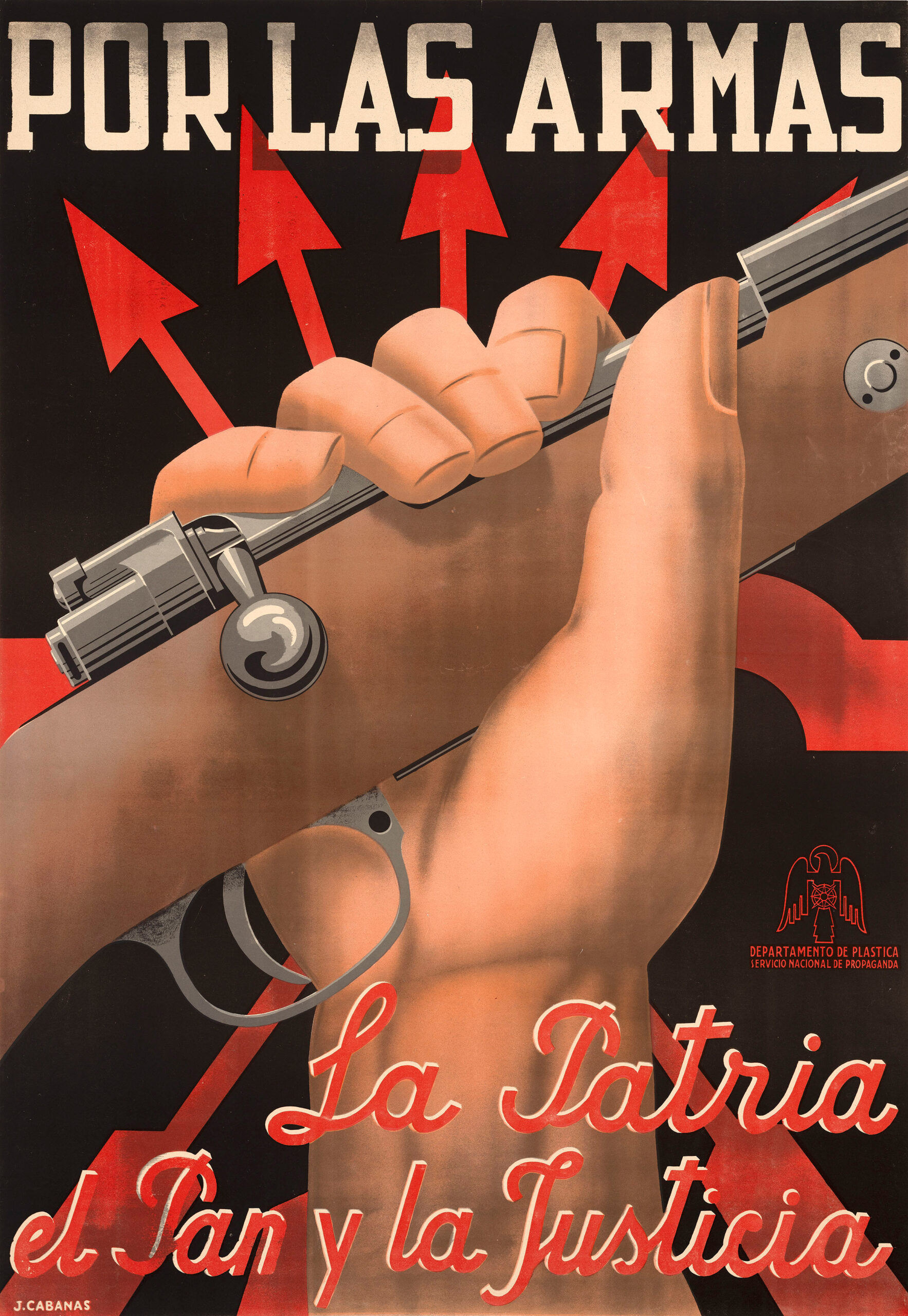
Propaganda poster from 1938 issued by the Falange Española (Spanish Phalanx) during the Spanish Civil War. Occupying the center of the poster is a raised hand clutching a rifle, calling for military action to secure bread, justice and a homeland for the citizens of Spain. Caption reads “To Arms – For Fatherland, Bread and Justice”
Set against a backdrop depicting the yugo y flechas (yoke and arrows), the symbol of the fascist Falange Española, colloquially known as the Falange. The yugo y flechas has its roots in medieval Spain, symbolizing the marriage of King Ferdinand of Aragon to Queen Isabel of Castile, as well as the birth of Spain as a whole through the union of these two kingdoms. The first letters of two elements which comprise the symbol (Y for yugo [yoke] and F for flechas [arrows] in Spanish), correspond to first names of the two monarchs (using the older spelling of Ysabel for Queen Isabel).
The Falange Española is a fascist political organization founded on October 29th, 1933 by José Antonio Primo de Rivera. Taking its name from the heavy infantry formations of ancient Greece, it promoted the revival of the Spanish Empire and called revolutionary action to restructure the economy along syndicalist lines. Being anti-communist, anti-democratic and anti-liberal, their red-black color scheme can be interpreted as a tribute to their economically syndicalist roots. The Spanish Phalanx merged with the Juntas de Ofensiva Nacional-Sindicalista (JONS) to form a united front known as the FET y de las JONS, and played an important role in the civil war between 1936 and 1939 against the Republicans. Primo de Rivera and his Falangists were considered the more radical faction within Caudillo Francisco Franco’s government.
This poster was designed by avant-garde artist Juan Cabanas (1907-1979), the son of the impressionist painter Angel Cabanas Oteiza. In 1924, he moved to Madrid and studied at the Escuela de Bellas Artes de San Fernando (San Fernando School of Fine Arts). Two years later, Cabanas would move again to Paris where he discovered surrealism, experimenting with it in both the visual arts and literature. Later in his life, he would destroy all of his surrealist works, likely due to surrealism’s increasing association with revolutionary leftism, decadence, psychological subversion and Marxism. During the Spanish Civil War, Cabanas would become deeply embedded with the Falangist political apparatus, aligning himself ideologically and morally with authoritarian nationalist aesthetics and institutions. He created many posters for the Falange including this one, and was eventually appointed head of the Sección Plástica de Prensa y Propaganda (Visual Arts Section of the Press and Propaganda), part of the Delegación Nacional de Prensa y Propaganda (National Delegation of Press and Propaganda). In 1945, after the conclusion of the Spanish Civil War, he traveled to Buenos Aires, Argentina and Santiago, Chile to study mural painting.
Distributed by the Departamento de Plástica del Servicio Nacional de Propaganda (Plastic Arts Department of the National Propaganda Service), which was also part of the National Delegation of Press and Propaganda and responsible for producing posters, placards and other visual propaganda for the Spanish nationalists.
97.8 x 68.3 cm
Free shipping on orders over $50!
- Satisfaction Guaranteed
- No Hassle Refunds
- Secure Payments
Propaganda poster from 1938 issued by the Falange Española (Spanish Phalanx) during the Spanish Civil War. Occupying the center of the poster is a raised hand clutching a rifle, calling for military action to secure bread, justice and a homeland for the citizens of Spain. Caption reads “To Arms – For Fatherland, Bread and Justice”
Set against a backdrop depicting the yugo y flechas (yoke and arrows), the symbol of the fascist Falange Española, colloquially known as the Falange. The yugo y flechas has its roots in medieval Spain, symbolizing the marriage of King Ferdinand of Aragon to Queen Isabel of Castile, as well as the birth of Spain as a whole through the union of these two kingdoms. The first letters of two elements which comprise the symbol (Y for yugo [yoke] and F for flechas [arrows] in Spanish), correspond to first names of the two monarchs (using the older spelling of Ysabel for Queen Isabel).
The Falange Española is a fascist political organization founded on October 29th, 1933 by José Antonio Primo de Rivera. Taking its name from the heavy infantry formations of ancient Greece, it promoted the revival of the Spanish Empire and called revolutionary action to restructure the economy along syndicalist lines. Being anti-communist, anti-democratic and anti-liberal, their red-black color scheme can be interpreted as a tribute to their economically syndicalist roots. The Spanish Phalanx merged with the Juntas de Ofensiva Nacional-Sindicalista (JONS) to form a united front known as the FET y de las JONS, and played an important role in the civil war between 1936 and 1939 against the Republicans. Primo de Rivera and his Falangists were considered the more radical faction within Caudillo Francisco Franco’s government.
This poster was designed by avant-garde artist Juan Cabanas (1907-1979), the son of the impressionist painter Angel Cabanas Oteiza. In 1924, he moved to Madrid and studied at the Escuela de Bellas Artes de San Fernando (San Fernando School of Fine Arts). Two years later, Cabanas would move again to Paris where he discovered surrealism, experimenting with it in both the visual arts and literature. Later in his life, he would destroy all of his surrealist works, likely due to surrealism’s increasing association with revolutionary leftism, decadence, psychological subversion and Marxism. During the Spanish Civil War, Cabanas would become deeply embedded with the Falangist political apparatus, aligning himself ideologically and morally with authoritarian nationalist aesthetics and institutions. He created many posters for the Falange including this one, and was eventually appointed head of the Sección Plástica de Prensa y Propaganda (Visual Arts Section of the Press and Propaganda), part of the Delegación Nacional de Prensa y Propaganda (National Delegation of Press and Propaganda). In 1945, after the conclusion of the Spanish Civil War, he traveled to Buenos Aires, Argentina and Santiago, Chile to study mural painting.
Distributed by the Departamento de Plástica del Servicio Nacional de Propaganda (Plastic Arts Department of the National Propaganda Service), which was also part of the National Delegation of Press and Propaganda and responsible for producing posters, placards and other visual propaganda for the Spanish nationalists.
97.8 x 68.3 cm