Showing 13–24 of 35 results
-
Original maquette of Die Partei (The Party) by the esteemed sculptor Arno Breker, widely considered one of the official artists of the Third Reich. He is known for his monumental works that expressed Nazi ideals of classical beauty, strength, and heroism.
-
Original maquette of Die Wehrmacht (The Armed Forces) by the esteemed sculptor Arno Breker, widely considered one of the official artists of the Third Reich. He is known for his monumental works that expressed Nazi ideals of classical beauty, strength, and heroism.
-
Amongst the most iconic posters of the Second World War, an election poster depicting the Führer and bearing the famous nationalist slogan “Ein Volk, ein Reich, ein Führer!” (One people, one realm, one leader!)
-
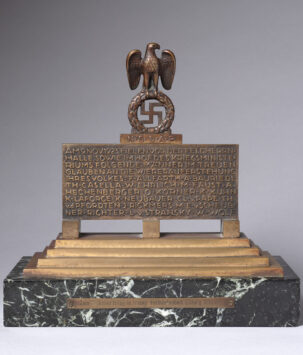
A 1:10 scale bronze of the revered Mahnmal der Bewegung, a memorial commemorating the Munich Beer Hall Putsch of November 9th, 1923 which essentially acted as a headstone consecrating a sacred Nazi tomb for the fallen insurrectionists. The face of the monument bears the names of the 16 martrys, while the obverse reads “Und ihr habt doch gesiegt!” (And yet you triumphed!) celebrating the National Socialist spirit of martyrdom. Commissioned as a gift to Ludwig Schroff of Schroff-Druck in Augsburg.
-
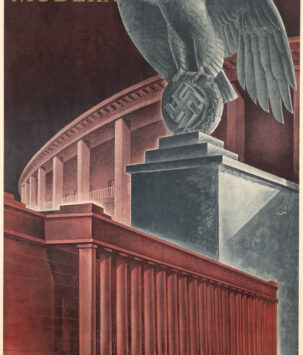
Tourism poster promoting Germany’s new developments in architecture. Fascist architectural design took inspiration from Ancient Rome and was intended to serve as awe-inspiring references to the great classical world as well as an expression of the regime’s infallible might. Through its synthesis of modernism and classicism, the style sought to articulate a powerful political ethos oriented towards the future yet equally grounded in tradition.
Architecture played a central role in Hitler’s desires to awaken a new national consciousness through reinvigorating German culture. Architectural projects were centered around the cultural life of its citizens, drawing from the Hellenic tradition of the polis as the site of a beautiful or good life. In the Gesamtkunstwerk (total work of art) that is the fascist nation-state, its citizens are not only never far from their spiritual tradition as expressed through architecture, but constitute a part of it.
-
A poster from 1943 which reflects the grim determination with which the German populace faced its fate during the last years of the war.
-
Cast iron sculpture from the German Army (Heer) headquarters in Paris, made to commemorate the Norwegian campaign of 1940.
-
1932 election poster for Adolf Hitler capitalizing on his unmistakable features. His party would go on to win the following 1933 German federal election securing 44% of the national vote.
-
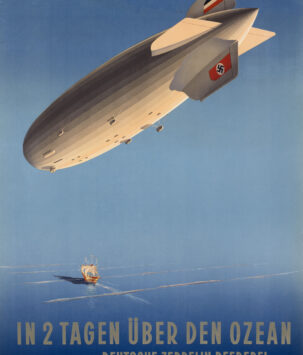
Poster by Ottomar Anton depicting the Hindenburg crossing the Atlantic, cleverly juxtaposed with an archaic merchant vessel to emphasize the speed of the new airship.
-
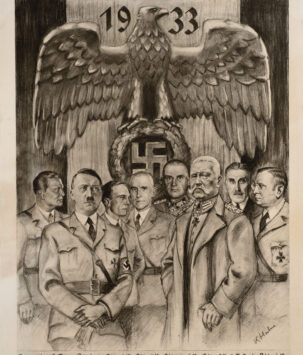
Poster commemorating the ascension of National Socialism in 1933, commonly referred to as the National Socialist ‘Revolution’.
-
Finely sculpted bronze Reichsadler by Professor Kurt Schmid-Ehmen, and having served as the basis for the design used by various state institutions within Germany until 1945.
-
Ceremonial trumpet recovered from Benito Mussolini’s estate. Notable for its stunning fusion of Fascist Italian and Nazi German visual symbolism.