Showing 73–84 of 122 results
-
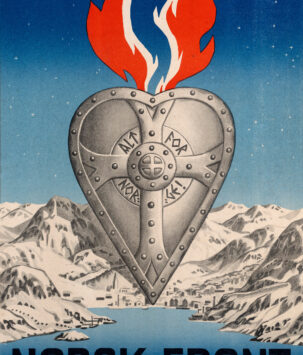
Late-war propaganda poster (c. 1945) from German-occupied Norway (Reichskommissariat Norwegen). Replaces the symbolism of the Sacred Heart of Jesus from Christianity with a fascist analogue that reinforces the iron determination of the Norwegian homefront.
-
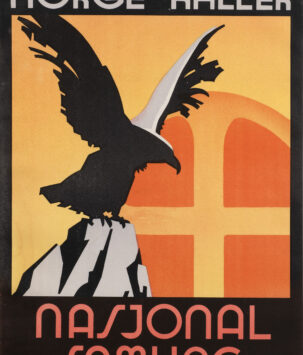
Election poster from Norway’s Nasjonal Samling (National Assembly), founded in 1933 by Vidkun Quisling. The sun in the form of a pagan sun cross rises behind a raven which was venerated in old Norse Viking mythology as Odin’s divine messenger. Akin to the German National Socialists they were modeled on, the Nasjonal Samling rejected Christianity and drew much of its imagery from paganism which they saw as a more authentically Norwegian faith. Quisling and his party collaborated with the Germans upon the invasion of Norway. Following his deposition in 1945, the very term ‘Quisling’ would later become synonymous with ‘traitor’ in the Scandinavian languages.
-
A 1942 recruitment poster from German-occupied Norway. Portrays the Schutzstaffel as the spiritual heirs to Norway’s Vikings, encouraging its youth to join the organization.
-
A commemorative 1939 Nazi Party trophy donated by the municipality of Hermannsburg. Bears the famous Nazi slogan “Ein Reich, Ein Volk, Ein Führer” on the obverse, with a dedication inscribed on the reverse.
-
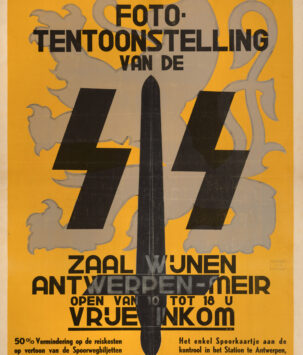
Poster from occupied Flanders advertising a photo exhibition for the SS. The runic insignia of the SS flank a sword to the backdrop of a Flemish lion.
-
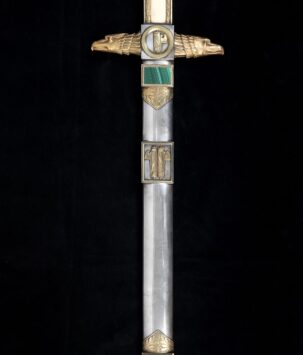
Ceremonial gladius awarded to Marshal Pietro Badoglio upon his conquest of Ethiopia in 1936.
-
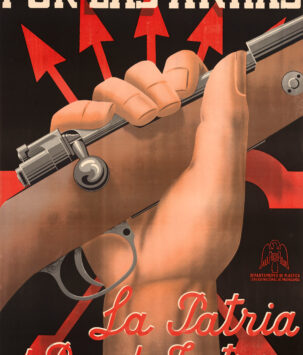
Propaganda poster issued by Falange Española (Spanish Phalanx) during the Spanish Civil War. A raised arm clutching a rifle, set against a backdrop depicting the red-black yugo y flechas (yoke and arrows), the symbol of the Falange. Designed by Juan Cabanas, a Spanish avant-garde artist and former head of the Falangist Sección Plástica de Prensa y Propaganda (Visual Arts Section of the Press and Propaganda).
-
Framed charcoal portrait of SS-Obergruppenführer Reinhard Heydrich, dated 1937.
-
The gilded Parteiadler which once adorned the very entrance to Adolf Hitler’s private living quarters in the Old Reich Chancellery. It is believed that there were only twelve such wall-mounted eagles, with examples today thought to only exist in the Imperial War Museum and Moscow’s Museum of the Great Patriotic War.
-
An illustration of a cohort of German athletes participating in the Reich Sports Week. The Nazi regime placed great emphasis on the physical fitness of its people, seeing sports as a means to harden spirits of its people and make them feel they were part of a wider national purpose.
-
A large, imposing, period bronze eagle set on a marble base embossed with the slogan “Ein Volk! Ein Reich! Ein Führer!” (One People! One Empire! One Leader!) referring to the spiritual unity of Germany through blood, soil and the Führer.
-
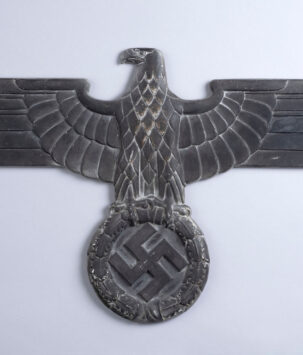
Eagle pulled off a locomotive of the Deutsche Reichsbahn, Nazi Germany’s state-owned railway enterprise. Originally in silver aluminum, these eagles began being coated in matte-black towards the end of the war as anti-aerial camouflage as German air superiority waned. The resulting appearance is a rather menacing and ominous one compared to its early-war silver counterpart. This aesthetic transition is reflective of the regime’s inward repression that only heightened as the war situation continued to deteriorate.