Type 93 Gas Mask
Japan was the only nation in the Second World War to employ biochemical warfare as part of its official military doctrine, resulting in a ghoulish aesthetic unique to the Sino-Japanese front.

Showing 109–120 of 122 results

Japan was the only nation in the Second World War to employ biochemical warfare as part of its official military doctrine, resulting in a ghoulish aesthetic unique to the Sino-Japanese front.

Flemish recruitment poster for the Waffen-SS featuring the character Tijl Uilenspiegel.

A recruitment poster c. 1929 for the paramilitary veteran’s organization Der Stahlehm. Eyes obscured by the shadow cast by his helmet, the soldier’s austere gaze is set upon the reader. To the backdrop of the Imperial German tricolor, the reader is posed the simple question of “And you?”, urging Germany’s citizens to do their part for their Fatherland.
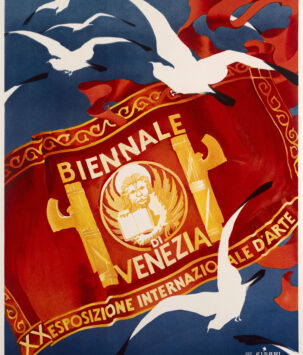
An Italian poster promoting the Venice Biennale of 1936. Features a Fascist iteration old flag of the Republic of Venice.

Propaganda poster from German-occupied France calling for a European crusade against Bolshevism. Note the lack of border between France and Germany.
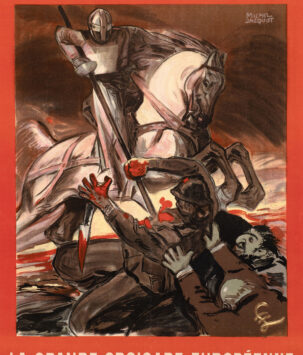
Propaganda poster from German-occupied France, depicting a European knight riding forth valiantly, impaling a Bolshevik soldier propped up by figures representing Judeo-capitalism. Medieval romanticism and the imagery of knightly warriors are frequent motifs in nationalist aesthetics, embodying pre-enlightenment ideals of masculinity, nobility, tradition, and martial valor.
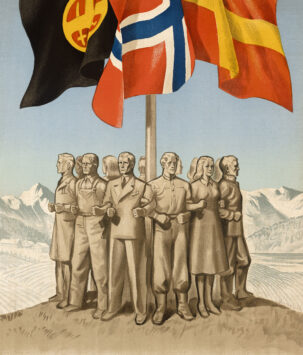
“Vi vil oss et land” (lit. ‘We want ourselves a country’) is a well-known nationalist slogan in Norway, derived from a poem by Per Sivle.
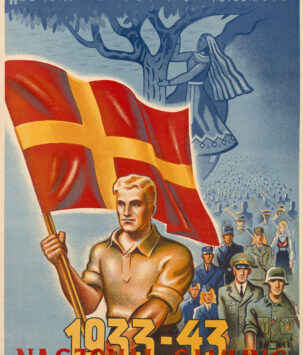
A Norwegian poster calling on its citizens to each fulfill their duty in restoring their nation’s past glory.

Propaganda poster by the Vlaams Nationaal Verbond (VNV), a catholic Flemish nationalist organization that sought secession from Belgium.
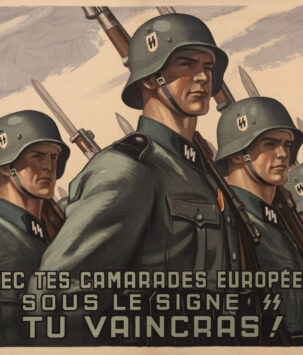
A recruitment poster from occupied France calling on its inhabitants to join the Waffen-SS alongside their fellow European comrades.
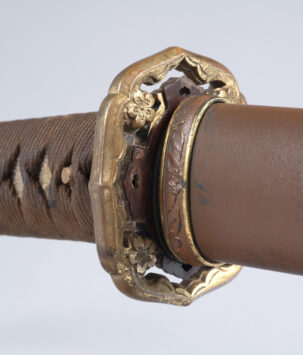
Katana forged in the fires of the notorious Yasukuni Shrine, within which are enshrined all fallen members of the Imperial Japanese armed forces. It is said that this blade is imbued with the spirits of these martyrs. Yasukuni Shrine is a Shinto shrine in Tokyo, founded to honor the spirits of those who gave their lives in service to the Emperor. Amongst the enshrined 2.5 million names are 1,068 convicted war criminals, including several Class A war criminals. In 1933, the radical fascist Minister of War, General Sadao Araki founded the Nihon-tō Tanrenkai (Japanese Sword Forging Association) in the grounds of the shrine to preserve old forging methods and promote Japan’s samurai traditions, as well as to meet the huge demand for katanas which all military officers were mandated to carry.
