Showing 37–48 of 69 results
-
“He [King Heinrich I] was the first among equals, and was met with a reverence greater and truer than ever accorded to the many emperors, kings, and princes that followed, who demanded it through alien Byzantine ceremony. He was called a duke and a king, and was our Führer of a thousand years ago.” — Reichsführer-SS Heinrich Himmler
-
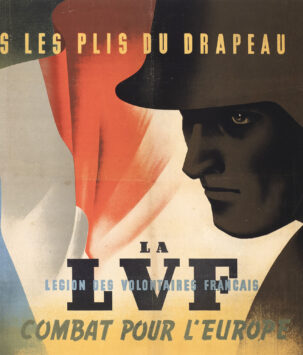
A poster promoting the collaborationist Légion des volontaires français (LVF). The LVF was a military unit composed of Frenchmen who fought for the German Wehrmacht during the Second World War, ostensibly to defend Europe against Bolshevism. It was later redesignated the Waffen-SS “Charlemagne” Brigade named after the legendary medieval Frankish King Charlemagne. The LVF originated as an independent initiative by a coalition of far-right factions in Vichy France who were disillusioned with the liberalism of the Third Republic.
The Charlemagne Brigade distinguished itself in the Battle of Berlin in 1945, where it remained as one of the last active defenders in the area of Hitler’s Führerbunker complex in a powerful demonstration of chivalric gallantry befitting of their namesake.
-
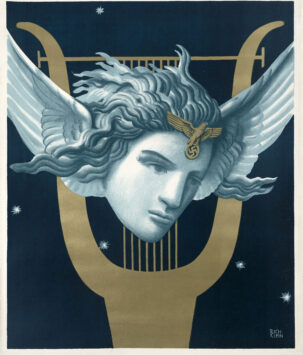
A Third Reich era print by Richard Klein paying homage to the idea of music and its genius. Head with wings and National Socialist party insignia on forehead, golden lyre behind it, set against a celestial backdrop, signifying the timeless, immaterial and elevated nature of music.
-
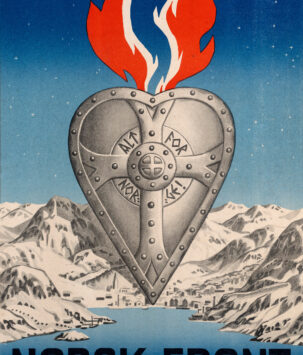
Late-war propaganda poster (c. 1945) from German-occupied Norway (Reichskommissariat Norwegen). Replaces the symbolism of the Sacred Heart of Jesus from Christianity with a fascist analogue that reinforces the iron determination of the Norwegian homefront.
-
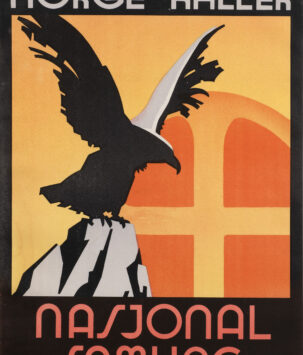
Election poster from Norway’s Nasjonal Samling (National Assembly), founded in 1933 by Vidkun Quisling. The sun in the form of a pagan sun cross rises behind a raven which was venerated in old Norse Viking mythology as Odin’s divine messenger. Akin to the German National Socialists they were modeled on, the Nasjonal Samling rejected Christianity and drew much of its imagery from paganism which they saw as a more authentically Norwegian faith. Quisling and his party collaborated with the Germans upon the invasion of Norway. Following his deposition in 1945, the very term ‘Quisling’ would later become synonymous with ‘traitor’ in the Scandinavian languages.
-
A 1942 recruitment poster from German-occupied Norway. Portrays the Schutzstaffel as the spiritual heirs to Norway’s Vikings, encouraging its youth to join the organization.
-
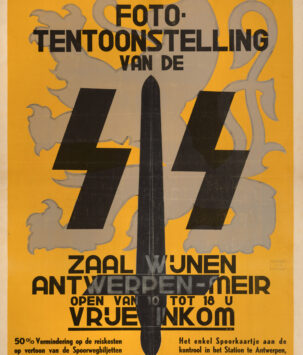
Poster from occupied Flanders advertising a photo exhibition for the SS. The runic insignia of the SS flank a sword to the backdrop of a Flemish lion.
-
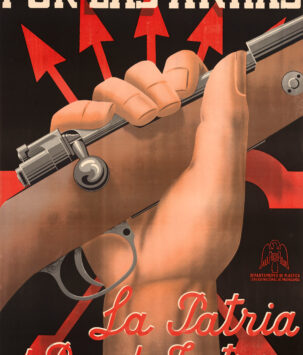
Propaganda poster issued by Falange Española (Spanish Phalanx) during the Spanish Civil War. A raised arm clutching a rifle, set against a backdrop depicting the red-black yugo y flechas (yoke and arrows), the symbol of the Falange. Designed by Juan Cabanas, a Spanish avant-garde artist and former head of the Falangist Sección Plástica de Prensa y Propaganda (Visual Arts Section of the Press and Propaganda).
-
An illustration of a cohort of German athletes participating in the Reich Sports Week. The Nazi regime placed great emphasis on the physical fitness of its people, seeing sports as a means to harden spirits of its people and make them feel they were part of a wider national purpose.
-
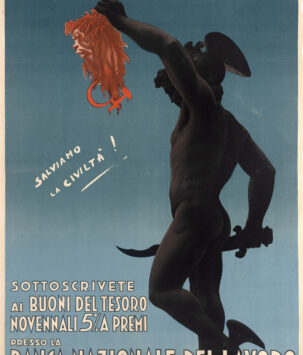
Poster depicting a Hellenic figure raising the decapitated ape-like head of communism in triumph. Frames the fight against communism as a civilization struggle for the preservation of European order, continuity and culture.
-
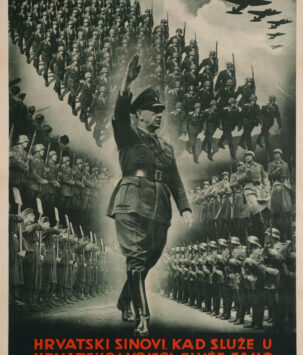
Army recruitment poster from the Independent State of Croatia. The leader Ante Pavelić can be seen at the forefront saluting his fascist legions with an address to the nation.
-
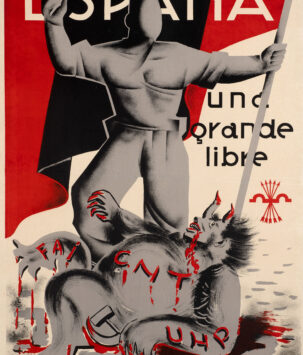
Spanish poster depicting a triumphant Falangist soldier standing atop a bloodied Marxist beast. The Falange Española (Spanish Phalanx) is a fascist political organization founded by José Antonio Primo de Rivera, taking its name from the heavy infantry formations of ancient Greece. It promoted the revival of the Spanish Empire, called for a national syndicalist economy and partook in the Spanish Civil War.