Flemish-German Culture Days – Ghent
Poster for a Flemish-German cultural exchange held in Ghent. The famous Gravensteen can be seen forming the backdrop.

Showing 25–36 of 69 results

Poster for a Flemish-German cultural exchange held in Ghent. The famous Gravensteen can be seen forming the backdrop.

Poster bearing the insignia of the fascist paramilitary Hirden, the armed wing of the revolutionary nationalist political party Nasjonal Samling. Calls for Norway’s ‘reconstruction’ or ‘regeneration’.

Poster from the formerly Nazi-aligned Dutch Confederation of Trade Unions (NVV). Under German supervision, the NVV oversaw a period of substantial industrial growth in the Netherlands between 1940-45.

Poster from the Vlaamsch Nationaal Verbond (Flemish National League, VNV).
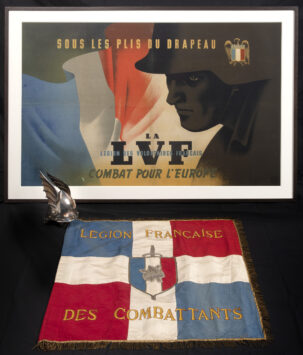
The Légion des volontaires français (LVF) was a collaborationist unit composed of Frenchmen who fought to defend Europe against Bolshevism. It was later redesignated as the Waffen-SS ‘Charlemagne’ Brigade, named after the legendary medieval Frankish King Charlemagne. The LVF originated as an independent initiative by a coalition of far-right factions in Vichy France who were disillusioned with the liberalism of the Third Republic. The Legion’s flagpole top seen here is a winged helmet of ancient Gaul, and alongside the unit’s later identification with the legend of Charlemagne, we see the clear and distinct influence of romantic historicism and French national mythology. The Waffen-SS ‘Charlemagne’ Brigade distinguished itself in the Battle of Berlin in 1945, where it remained as one of the last defenders around Hitler’s Führerbunker.
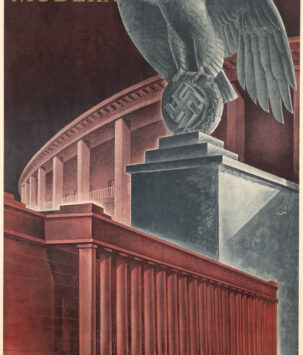
Tourism poster promoting Germany’s new developments in architecture. Fascist architectural design took inspiration from Ancient Rome and was intended to serve as awe-inspiring references to the great classical world as well as an expression of the regime’s infallible might. Through its synthesis of modernism and classicism, the style sought to articulate a powerful political ethos oriented towards the future yet equally grounded in tradition.
Architecture played a central role in Hitler’s desires to awaken a new national consciousness through reinvigorating German culture. Architectural projects were centered around the cultural life of its citizens, drawing from the Hellenic tradition of the polis as the site of a beautiful or good life. In the Gesamtkunstwerk (total work of art) that is the fascist nation-state, its citizens are not only never far from their spiritual tradition as expressed through architecture, but constitute a part of it.

A poster from 1943 which reflects the grim determination with which the German populace faced its fate during the last years of the war.

1932 election poster for Adolf Hitler capitalizing on his unmistakable features. His party would go on to win the following 1933 German federal election securing 44% of the national vote.
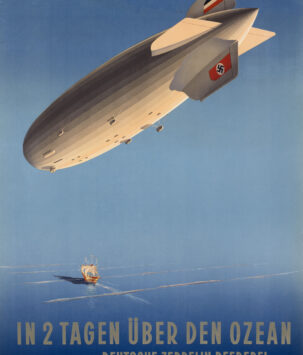
Poster by Ottomar Anton depicting the Hindenburg crossing the Atlantic, cleverly juxtaposed with an archaic merchant vessel to emphasize the speed of the new airship.
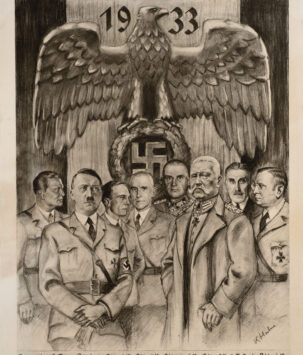
Poster commemorating the ascension of National Socialism in 1933, commonly referred to as the National Socialist ‘Revolution’.

Flemish recruitment poster calling on its youth to join the SS-Sturmbrigade Langemarck (SS Assault Brigade Langemarck) formed in 1943.
