With the VNV for Our People
Propaganda poster by the Vlaams Nationaal Verbond (Flemish National League, VNV) from Flanders, Belgium. The VNV was a devoutly catholic, Flemish nationalist organization founded in Belgium in 1933 by Flemish frontline veterans of the First World War. Having been embittered by the Great War and long oppressed by the French-speaking Walloon minority which dominated the Belgian government, their primary goal was to form an independent Flemish state. The party rejected the illegitimate Belgian nation-state, and advocated for the unification of Flanders, the Netherlands and other Flemish regions in northern France into a single polity known as Dietsland, otherwise known as the ‘Greater Netherlands’. The symbol of the VNV can be seen next to the Flemish coat of arms: a triangle within a circle, with the circle representing the union of the regions and the triangle representing the delta formed by the Rhine, Meuse and Scheldt rivers.
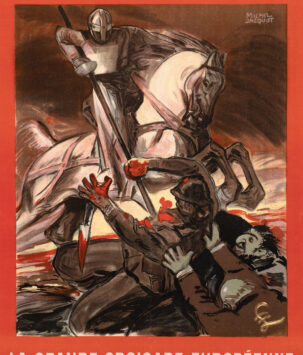
The German occupation of Belgium was regarded as an opportunity by the VNV, which submitted to collaboration. The VNV was involved in the civil administration of German-occupied Flanders while also establishing the Flemish Legion, a foreign volunteer formation within the Wehrmacht (and later, Waffen-SS). Hitler himself is said to have stated of his Flemish soldiers that they “have indeed shown themselves on the Eastern Front to be more pro-German and more ruthless than the Dutch legionaries”. The élan displayed by these Flemings reflects the imagery of their medieval knightly ancestor as featured in this poster, a parallel it seeks to emphasize in no unclear terms. The VNV is responsible for having produced other similar posters which also invoke medievalist imagery in an bid to tap into the martial tradition of Flanders.
“Flanders must join the new order, born of the National Socialist revolution. This order can only be established on the basis of a pure and true popular consciousness, which for the people of Flanders means the awareness of its Dutch character and the sense of Germanic solidarity for which Germanic honor and duty demand.
Therefore, the task of the movement consists of arousing and strengthening popular national consciousness in Flanders, in educating all fellow citizens in a National Socialist spirit, to subordinate personal and group interests to the well-being of the Volksgemeinschaft [people’s community] and in converting this popular alliance into a political, cultural and social economic order.
Healthy political-national construction must be carried out on a national basis. This new political order must be established, partly on the principle of leadership, and partly on the elimination and rejection of all institutions, groups or expressions that affect or undermine the organic unity of the people’s community.
The cultural order must serve the construction of a truly national culture, that is to say, a culture that in all its manifestations is the reflection of national identity. As such, as a means of maintaining and perfecting it, the social order will be based on the recognition of work as a service to the wider community and as the highest duty for all. The solidarity of workers of every kind and of every rank, of leaders and of followers, whose solidarity must be built on mutual respect, loyalty and the duty of the community to ensure a humane existence for all diligent fellow citizens. The economic order will be aimed at the realization of a twofold principle: property is service and the interest of the community takes precedence over the interest of groups and individuals. In recognizing private initiative, the organization of businesses must aim to make the national economy an ordered, bound whole of the entire Volk (people). When everyone understands their duty, our Flemish, Dutch and Germanic resurrection will grow out of the current chaos in the new order.” – Leader of the VNV, Staf de Clercq (1940)
Text reads: With the V.N.V for our people
Free shipping on orders over $50!
- Satisfaction Guaranteed
- No Hassle Refunds
- Secure Payments
Propaganda poster by the Vlaams Nationaal Verbond (Flemish National League, VNV) from Flanders, Belgium. The VNV was a devoutly catholic, Flemish nationalist organization founded in Belgium in 1933 by Flemish frontline veterans of the First World War. Having been embittered by the Great War and long oppressed by the French-speaking Walloon minority which dominated the Belgian government, their primary goal was to form an independent Flemish state. The party rejected the illegitimate Belgian nation-state, and advocated for the unification of Flanders, the Netherlands and other Flemish regions in northern France into a single polity known as Dietsland, otherwise known as the ‘Greater Netherlands’. The symbol of the VNV can be seen next to the Flemish coat of arms: a triangle within a circle, with the circle representing the union of the regions and the triangle representing the delta formed by the Rhine, Meuse and Scheldt rivers.
The German occupation of Belgium was regarded as an opportunity by the VNV, which submitted to collaboration. The VNV was involved in the civil administration of German-occupied Flanders while also establishing the Flemish Legion, a foreign volunteer formation within the Wehrmacht (and later, Waffen-SS). Hitler himself is said to have stated of his Flemish soldiers that they “have indeed shown themselves on the Eastern Front to be more pro-German and more ruthless than the Dutch legionaries”. The élan displayed by these Flemings reflects the imagery of their medieval knightly ancestor as featured in this poster, a parallel it seeks to emphasize in no unclear terms. The VNV is responsible for having produced other similar posters which also invoke medievalist imagery in an bid to tap into the martial tradition of Flanders.
“Flanders must join the new order, born of the National Socialist revolution. This order can only be established on the basis of a pure and true popular consciousness, which for the people of Flanders means the awareness of its Dutch character and the sense of Germanic solidarity for which Germanic honor and duty demand.
Therefore, the task of the movement consists of arousing and strengthening popular national consciousness in Flanders, in educating all fellow citizens in a National Socialist spirit, to subordinate personal and group interests to the well-being of the Volksgemeinschaft [people’s community] and in converting this popular alliance into a political, cultural and social economic order.
Healthy political-national construction must be carried out on a national basis. This new political order must be established, partly on the principle of leadership, and partly on the elimination and rejection of all institutions, groups or expressions that affect or undermine the organic unity of the people’s community.
The cultural order must serve the construction of a truly national culture, that is to say, a culture that in all its manifestations is the reflection of national identity. As such, as a means of maintaining and perfecting it, the social order will be based on the recognition of work as a service to the wider community and as the highest duty for all. The solidarity of workers of every kind and of every rank, of leaders and of followers, whose solidarity must be built on mutual respect, loyalty and the duty of the community to ensure a humane existence for all diligent fellow citizens. The economic order will be aimed at the realization of a twofold principle: property is service and the interest of the community takes precedence over the interest of groups and individuals. In recognizing private initiative, the organization of businesses must aim to make the national economy an ordered, bound whole of the entire Volk (people). When everyone understands their duty, our Flemish, Dutch and Germanic resurrection will grow out of the current chaos in the new order.” – Leader of the VNV, Staf de Clercq (1940)
Text reads: With the V.N.V for our people