SS Volunteer Legion Flanders
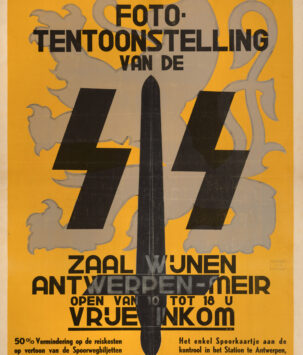
A commemorative postwar poster created for the veterans association Sint-Maartenfons in the 1960s to honor of those who served in the Flemish SS Volunteer Legion. The artist, Frans van Immerseel, was himself a Flemish Schutzstaffel (SS) member of the Germanic SS, known to have created two other posters for the National Socialists during the war.
Flemings have long existed as second-class citizens within their native country of Belgium, dominated since its inception by the French-speaking Walloon population. Upon the Belgium’s occupation by Nazi Germany in 1940, many Flemish citizens took the opportunity to collaborate with the occupiers in the hopes of garnering their blessings to ultimately achieve independence after the war. These pro-German sympathies, alongside the German military’s desire to augment its manpower shortages with foreign recruits, officiated the creation of a Flemish volunteer legion that would take up arms alongside their German comrades in the East. In fact, many western Europeans at the time saw Germany’s fight against the Soviet Union as their own, prompting German recruitment efforts to capitalize on this narrative of a pan-European, civilizational struggle against Bolshevism to bolster enlistments.
The Flemish volunteer unit was officially designated the SS-Freiwilligen Legion Flandern (SS Volunteer Legion Flanders) upon its formation in 1940, to highlight the voluntary character of the unit. Its men were depicted as individuals who chose to stand with Germany in Europe’s hour of need, and bestowed the Flemings honor and prestige as ideological comrades-in-arms rather than as reluctant conscripts. The unit was reformed as the SS-Sturmbrigade Langemarck (SS Assault Brigade Langemarck) in 1943, before undergoing a final redesignation as the 27th SS Volunteer Grenadier Division Langemarck towards the end of the war. By reviving the word Grenadier, the SS linked their modern infantry formations to the elite shock troops of Europe’s martial golden age. A Fleming wearing the title of “grenadier” could take pride in being part of an honored soldiering tradition that stretches back to the guards of Napoleon and Frederick the Great.
The legion partook in heavy fighting on the eastern front where the Flemish Waffen-SS volunteers would come to be noted for their courage and particular combat effectiveness amongst their European peers. Adolf Hitler himself is said to have stated of the Flemings they “have indeed shown themselves on the Eastern Front to be more pro-German and more ruthless than the Dutch legionaries”.
Depicts three Flemish legionnaires mounting an assault to an awe-inspiring backdrop dominated by the ascendant Flemish lion, a longstanding feudal motif dating back to the Early Middle Ages, and a symbol of Flanders’ martial pride and tenacity.
On the bottom margin is an unidentified signature and a stamp of the Graven in het Oosten (Graves in the East), an organization that is part of the aforementioned Sint-Maartenfons veterans association.
Free shipping on orders over $50!
- Satisfaction Guaranteed
- No Hassle Refunds
- Secure Payments
A commemorative postwar poster created for the veterans association Sint-Maartenfons in the 1960s to honor of those who served in the Flemish SS Volunteer Legion. The artist, Frans van Immerseel, was himself a Flemish Schutzstaffel (SS) member of the Germanic SS, known to have created two other posters for the National Socialists during the war.
Flemings have long existed as second-class citizens within their native country of Belgium, dominated since its inception by the French-speaking Walloon population. Upon the Belgium’s occupation by Nazi Germany in 1940, many Flemish citizens took the opportunity to collaborate with the occupiers in the hopes of garnering their blessings to ultimately achieve independence after the war. These pro-German sympathies, alongside the German military’s desire to augment its manpower shortages with foreign recruits, officiated the creation of a Flemish volunteer legion that would take up arms alongside their German comrades in the East. In fact, many western Europeans at the time saw Germany’s fight against the Soviet Union as their own, prompting German recruitment efforts to capitalize on this narrative of a pan-European, civilizational struggle against Bolshevism to bolster enlistments.
The Flemish volunteer unit was officially designated the SS-Freiwilligen Legion Flandern (SS Volunteer Legion Flanders) upon its formation in 1940, to highlight the voluntary character of the unit. Its men were depicted as individuals who chose to stand with Germany in Europe’s hour of need, and bestowed the Flemings honor and prestige as ideological comrades-in-arms rather than as reluctant conscripts. The unit was reformed as the SS-Sturmbrigade Langemarck (SS Assault Brigade Langemarck) in 1943, before undergoing a final redesignation as the 27th SS Volunteer Grenadier Division Langemarck towards the end of the war. By reviving the word Grenadier, the SS linked their modern infantry formations to the elite shock troops of Europe’s martial golden age. A Fleming wearing the title of “grenadier” could take pride in being part of an honored soldiering tradition that stretches back to the guards of Napoleon and Frederick the Great.
The legion partook in heavy fighting on the eastern front where the Flemish Waffen-SS volunteers would come to be noted for their courage and particular combat effectiveness amongst their European peers. Adolf Hitler himself is said to have stated of the Flemings they “have indeed shown themselves on the Eastern Front to be more pro-German and more ruthless than the Dutch legionaries”.
Depicts three Flemish legionnaires mounting an assault to an awe-inspiring backdrop dominated by the ascendant Flemish lion, a longstanding feudal motif dating back to the Early Middle Ages, and a symbol of Flanders’ martial pride and tenacity.
On the bottom margin is an unidentified signature and a stamp of the Graven in het Oosten (Graves in the East), an organization that is part of the aforementioned Sint-Maartenfons veterans association.