Showing 1–12 of 56 results
-
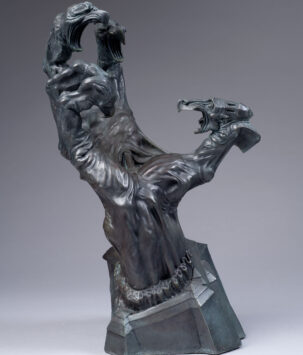
Sculpture by Stanisław Szukalski as featured in the eponymous Netflix documentary, Struggle. Created in 1917, this piece depicts the infighting of the great powers of Europe during the First World War. The hand representing European civilization, the opposing fingers, or nations of Europe, turn against one another failing to recognize they are but part of one entity.
-
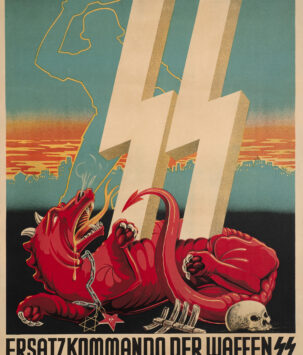
Belgian recruitment poster for the Waffen-SS replacement troops. Illustrated by F. Bertau in 1944, the poster is unparalleled in its dynamism and visual literacy. The potent symbolism and cartoonish style make the piece both unique to the era and unlike any other from it. A visually entertaining poster that manages to non-verbally communicate all its intended ideas through its vivid composition and succinct symbolism.
-
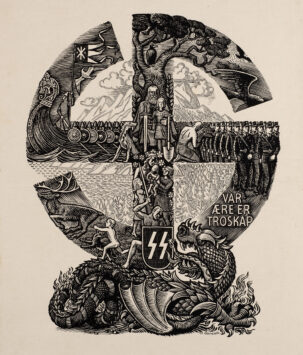
Schutzstaffel (SS) recruitment poster from German-occupied Norway brimming with mythological imagery from Germanic Paganism. Found within this poster is a profound esoteric symbology that captures the essence of neopagan National Socialist cosmology. Combining the quadratic themes of each arm of the swastika presents a singular, divine whole. The horizontal axis represents temporality, with the left and right arms symbolizing past and present, respectively, while the vertical axis represents the theory of metaphysical dualism. An iconic element of Norway’s heritage, ancient Vikings warriors are reflected on the right by their modern descendants, legionnaires of the Norwegian Waffen-SS. In the center is the revered god of war, Odin. The cosmic tree Yggdrasil forms the top arm as the axis mundi of Norse cosmology, bridging the celestial realms to the terrestrial, rooted in our soil but with its branches reaching far into the heavens. A humble Aryan family and a valiant SS patriarch comprising the bottom arm can be seen defending his homestead from the ravenous dragon of Judeo-Bolshevism.
-
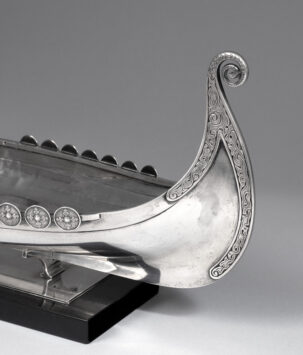
Silver longship awarded to SS-Obersturmbannführer Hans-Hendrik Neumann by Norwegian prime minister Vidkun Quisling for his advisory role during the German occupation.
-
Original service tunic of Léon Degrelle, the infamous Belgian fascist leader, Waffen-SS war hero and author.
-
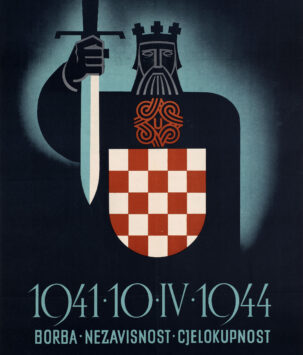
Poster celebrating the establishment of the Independent State of Croatia. An ethereal nimbus of light surrounds a king bearing the insignia of the Ustaše.
-
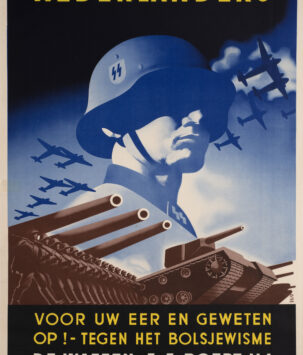
A potent Waffen-SS recruitment poster from the occupied Netherlands. An iconic piece of modern propaganda.
-
Dutch poster during the German occupation promoting an exhibition about the economic and cultural revival of the Netherlands. A Wolfsangel, the symbol of Dutch National Socialism, is displayed prominently in the middle. A sword and spade, symbolizing the dual pillars of National Socialism, surmount the Wolfsangel: The sword embodies the iron will of the ‘nation’ and its Volk, while the spade represents the ‘social’ commitment to self-improvement, charity, and compassion for fellow citizens in the pursuit of economic autarky.
-
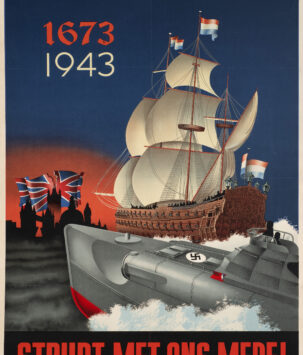
A poster from the German-occupied Netherlands juxtaposing an antiquated Dutch three-decker with a modern German U-boat with the Germanic allies setting sail for London. The Germans sought to win over the Dutch by reigniting feelings of the historical Anglo-Dutch naval rivalry. The two preeminent seafaring nations of western Europe can trace their enmity back to the year 1673 as referenced on the poster, during which the Third Anglo-Dutch War took place. It was the last successful invasion of the British isles by a foreign power.
-
A poster from the Flemish National Union (VNV). Employs medieval motifs unique to Flanders, above which hovers the secessionist symbol of the VNV: a circle representing the union of the Netherlands with greater Flanders, within which lies a triangle representing the delta formed by the Rhine, Meuse and Scheldt rivers.
-
A Greco-Roman structure can be seen flanked by Olympian fire pits, resembling Nazi Germany’s parade grounds. Announcing the 8th National Assembly in Norway, 1942.
-
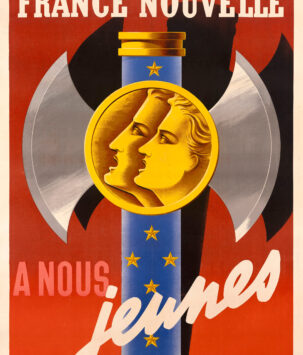
Propaganda poster issued the Secrétariat général de la Jeunesse (General Secretariat for Youth), a fascist youth administration created by the French Vichy Regime and modeled after Germany’s Hitler Youth. The Vichy regime rallied its youth against individualism, materialism and decadence and sought to morally, structurally and socially reshape France, utilizing posters such as these to promote the Révolution nationale (National Revolution).