Showing 13–24 of 56 results
-
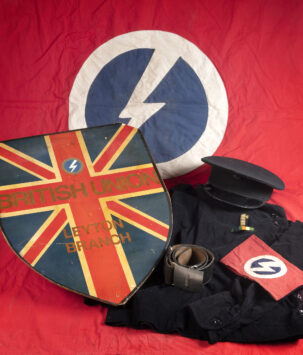
A collection of artifacts from the British Union of Fascists (BUF) including a flag, Leyton branch headquarters plaque, paramilitary peaked cap from the Fascist Defence Force and an officer’s tunic paired with a BUF armband and belt.
Members of the BUF wore the famous black shirt as their uniform, modelled on Sir Oswald Mosley’s fencing tunic. It was stated to be worn because the color best expressed the ‘iron determination’ of Fascism. By eliminating distinctions of dress, it also helped break down of class barriers. The tunics were ideological as well as practical, as in street fights the tunic offered little for an opponent to get a grip on.
-
Political standard of the British Union of Fascists, founded by Sir Oswald Mosley.
-
Uniform of the British Union of Fascists, modeled Sir Oswald Mosley’s fencing tunic.
-
Poster from occupied France calling on all Europeans to defend their civilization from Russian Bolshevism by fighting alongside the Germans on the Eastern Front. The Greek goddess of warfare, Athena, is employed as a unifying icon of a shared European heritage.
-
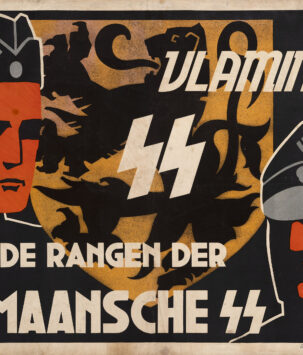
Poster addressing Flemings to join the ranks of the Germanic SS, collectively referring to SS organizations in Belgium, Denmark, the Netherlands and Norway, whose inhabitants were considered pureblooded aryans like the Germans themselves.
-
Poster for a Flemish-German cultural exchange held in Ghent. The famous Gravensteen can be seen forming the backdrop.
-
Poster bearing the insignia of the fascist paramilitary Hirden, the armed wing of the revolutionary nationalist political party Nasjonal Samling. Calls for Norway’s ‘reconstruction’ or ‘regeneration’.
-
Poster from the formerly Nazi-aligned Dutch Confederation of Trade Unions (NVV). Under German supervision, the NVV oversaw a period of substantial industrial growth in the Netherlands between 1940-45.
-
Poster from the Vlaamsch Nationaal Verbond (Flemish National League, VNV).
-
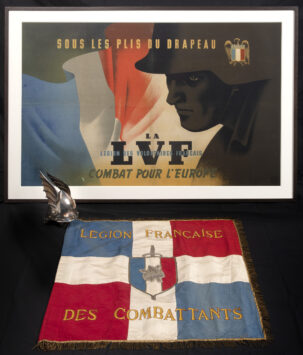
The Légion des volontaires français (LVF) was a collaborationist unit composed of Frenchmen who fought to defend Europe against Bolshevism. It was later redesignated as the Waffen-SS ‘Charlemagne’ Brigade, named after the legendary medieval Frankish King Charlemagne. The LVF originated as an independent initiative by a coalition of far-right factions in Vichy France who were disillusioned with the liberalism of the Third Republic. The Legion’s flagpole top seen here is a winged helmet of ancient Gaul, and alongside the unit’s later identification with the legend of Charlemagne, we see the clear and distinct influence of romantic historicism and French national mythology. The Waffen-SS ‘Charlemagne’ Brigade distinguished itself in the Battle of Berlin in 1945, where it remained as one of the last defenders around Hitler’s Führerbunker.
-
Uniform of the Hirden, a fascist Norwegian paramilitary organization. The term is derived from the medieval Scandinavian word for the king’s ‘hearth-guard’, and invoked Norway’s ancient warrior tradition to signal loyalty, honor and legitimacy.
-
Cast aluminum finial (pole top) from the Italian Social Republic (1943-1945), the hardline fascist successor state to the Kingdom of Italy.